
You have written your book. You have rewritten it. You sent it to your beta readers, perhaps a trusted colleague, a fellow writer from your book a WhatsApp Group, or a sharp-eyed friend in Mombasa, and then you rewrote it again. You hired an editor, fixed your grammar, and now you are absolutely certain you are ready to publish. Not quite. Before your book goes to print, there is one more critical step: the book proof.
This stage is often skipped by first-time authors, and it is almost always regretted. A book proof gives you one final, physical look at your book before your printer runs the full order. It is your last chance to catch mistakes and in self-publishing, the cost of fixing errors after printing falls entirely on you.
What Is a Book Proof?
A book proof, also called a proof copy — is a pre-publication version of your finished book. It comes after your manuscript has been typeset and designed, but before you authorise a full print run. You use it to verify that every element of the book is exactly as you intended: the text, the cover, the images, the page numbers, and all the fine details in between.
The word “proofreading” actually derives from this process: the practice of reading from a physical proof before publication. For Kenyan writers publishing independently, ordering a proof copy is not an optional luxury. It is a professional necessity.
Proof Copies, Galleys, and ARCs: What Is the Difference?
These three terms are often confused, and understanding the difference will help you manage your publishing timeline more effectively.
- Galley Copies
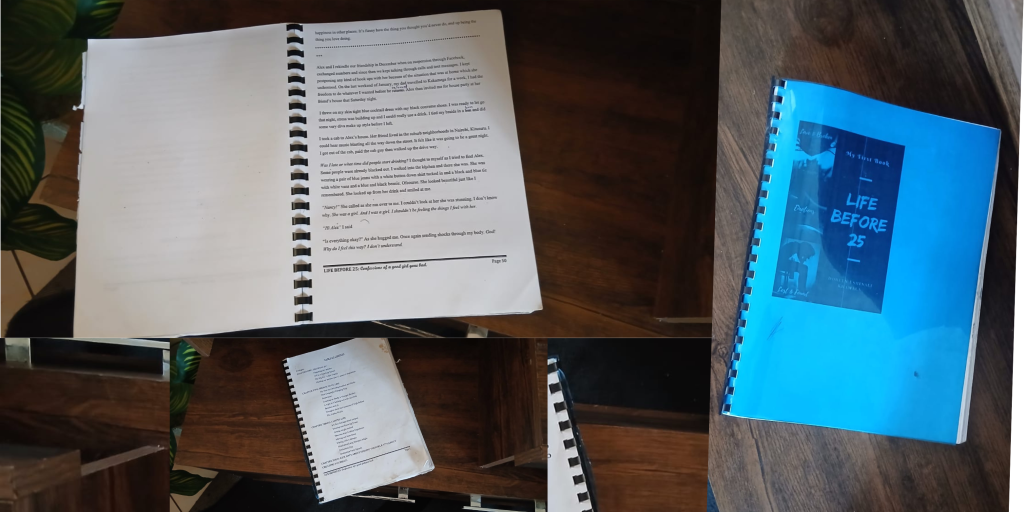
Traditionally, a galley was a basic, coil-bound print of your manuscript: body text only, no cover, no front matter, no formatting. A galley is purely a tool for editing, and in traditional publishing houses it was usually shared only with the editor. For most self-publishing Kenyan authors, galleys are rarely used today; digital manuscripts sent to editors serve the same purpose.
This was my galley back in 2017 for my very first book.
- Advance Reader Copies (ARCs)
An ARC is a near-complete version of your book. It includes the cover, front and back matter, photographs, and most of the final formatting. ARCs are sent to reviewers, fellow authors, and literary bloggers – people whose endorsements you want to appear on your cover or in your launch campaign before the book officially goes on sale.
For Kenyan writers building an audience locally and online, ARCs are a valuable marketing tool. Book reviewers in Kenya, literary journalists, and popular reading communities on social media platforms are all good targets for your ARCs. Importantly, ARCs no longer need to be printed, most reviewers today are happy to receive a PDF or ePub file, which saves you both time and money.
- Proof Copies
The proof copy is specifically for your own final quality check. Unlike an ARC, which is sent outward to reviewers, the proof copy is an internal tool. You, and perhaps your designer or editor, use it to confirm that everything is perfect before you authorise printing. Some distributors may also require a proof copy before agreeing to stock or list your book.
Why Book Proofs Matter for Kenyan Self-Publishers
When you self-publish, there is no traditional publisher absorbing the cost of production errors. If your finished books arrive with a typo on the cover, a misaligned image, or pages printed out of order, you bear that cost, financially and reputationally. A proof copy is your insurance against exactly these scenarios.
For Kenyan writers printing locally, whether through printers in Nairobi’s Industrial Area, along Mombasa Road, or through a regional printer in another county, always ask for a single physical proof copy before approving the full run. Even if your printer shows you a digital mockup, insist on holding the real thing. Screen colour and print colour differ, paper quality can surprise you, and binding can affect how the text sits on the page. None of this is visible on a screen.
For writers using international print-on-demand platforms such as Amazon KDP, these platforms offer a digital proof as standard but you should also order a physical proof copy before making your book available for sale. The small additional cost is worth every shilling.
What to Check in Your Book Proof: A Kenyan Author’s Checklist
Once your physical proof copy arrives, work through the following areas systematically. Do not rush this stage. Give yourself at least a week or two to commit to review it properly.
1. The Text
Yes, you have edited this manuscript many times over. But there is something about reading your book in physical form. Holding it, turning actual pages that causes you to notice things you missed on screen. Typos, repeated words, inconsistent punctuation, and awkward line breaks all become more visible in print.
Read through your proof carefully. When you are done, hand it to one other person, a fellow writer, a trusted reader, or a professional proofreader and ask them to read it with fresh eyes. You are too close to the text to catch everything yourself. A second reader is not a sign of weakness; it is simply good publishing practice.
2. Print Quality and Colour Accuracy
Your proof copy is the first time you will see your book as a physical object, not a digital file. Check the print quality carefully:
- Are the colours consistent with your digital proofs? There will always be some variation between screen and print: CMYK print colour differs from RGB screen colour, but you should not be surprised or disappointed by what you see.
- If your book contains photographs, illustrations, or maps, examine each one for moiré patterns, blurriness, or unexpected colour shifts.
- Check that text-heavy pages are sharp and readable, not faded or smudged.
- Look at the paper. Does it feel like the quality you specified and paid for?
For Kenyan writers printing with local printers, it is worth discussing colour profiles with your printer before the proof is produced. Ask whether they print in CMYK or RGB, and supply your files accordingly. Many printing problems arise simply from a mismatch between the file you submitted and the process the printer used.
3. The Cover
Your cover is the single most important visual element of your book. It is what draws a reader in at a bookshop on Kimathi Street, at the Nairobi Book Fair, or on an online retailer’s product page. Check it thoroughly:
- Is the front cover image centred and level?
- Does the spine text sit cleanly within the spine, without bleeding onto the front or back cover?
- Is the back cover text correctly formatted, readable, and free of errors?
- Is your barcode (if applicable) clean, correctly placed, and scannable?
- Are your cover colours vibrant and accurate to your design file?
If you worked with a Kenyan graphic designer for your cover, share the proof with them as well. A professional designer will spot technical problems, bleed errors, image resolution issues, colour inconsistencies that you may not immediately recognise.
4. Front and Back Matter
Most authors spend enormous energy editing the body of their book and then almost no time on the front and back matter. The proof stage is where this oversight catches up with you. Go through every page of your front and back matter carefully:
- Title page: Is your title, subtitle, and author name exactly right?
- Copyright page: Is the copyright year correct? Is your ISBN accurate? Are your edition details and legal notices in order?
- Dedication: Is it worded exactly as you intended?
- Table of contents: Do the page numbers in the table of contents match the actual pages where each chapter begins? This is one of the most common errors in self-published books.
- About the Author: Is your biography correct? Are your social media handles, website URL, and contact details current and accurate?
- Acknowledgements: Have you spelled every name correctly? This matters deeply to the people you are thanking.
- Back matter: If you have an appendix, bibliography, glossary, or index, check that each is complete and correctly formatted.
5. Page Numbers, Headers, and Footers
Flip through every page and check the following:
- Are page numbers present on all pages where they should appear, and absent on chapter opening pages, blank pages, and the title page?
- Are running headers correct throughout? The convention is your book title on the left-hand page and your chapter title on the right-hand page.
- Do headers disappear correctly at the start of each new chapter?
- Are there any pages where your name or title has been accidentally truncated or misaligned?
6. Typography and Formatting Consistency
Inconsistent formatting is one of the most reliable ways to signal an unprofessional self-published book. Use your proof to confirm:
- Are your fonts consistent throughout: body text, chapter headings, and subheadings all using the typefaces you specified?
- Are your paragraph breaks consistent? Do you indent the first line of each paragraph, or leave a line space between paragraphs? Whichever you chose, it should be uniform from the first page to the last.
- Are there any orphans or widows – single lines left stranded at the top or bottom of a page?
- Are all illustrations, maps, photographs, and diagrams placed correctly and at the right size?
- If your book uses chapter epigraphs, pull quotes, or other special elements, are they formatted consistently throughout?
Working with Your Printer in Kenya
Whether you are printing in Nairobi, Mombasa, Nakuru, or any other town, insist that your printer provides a proof copy before the full run begins. Any reputable printer, local or international, should offer this as a matter of course. If a printer refuses or tells you it is unnecessary, that is a warning sign worth heeding.
When you receive your proof, review it in good light and at a relaxed pace. If you identify corrections, communicate them clearly and in writing to your printer or designer. Keep a record of all changes requested and agreed upon.
For writers printing with international platforms from Kenya, build the cost and time for a physical proof into your publishing schedule. Allow at least two to three weeks for a proof copy to arrive by post if you are ordering from outside the country, and factor in time for any corrections before your planned launch date.
The proof stage is not a formality. It is the moment you hold your published book for the very first time. Treat it with the care and attention it deserves, and your readers will notice the difference on every page.




4 Comments
This is quite informative and coming in just when I need to know this. Keep up the good work.
Thank you Sue. I really do appreciate your feedback.
I missed alot of steps during the publishing of my first book.
I hear you.But know that learning happens on the way. I am glad to share what I have learned along the way.