
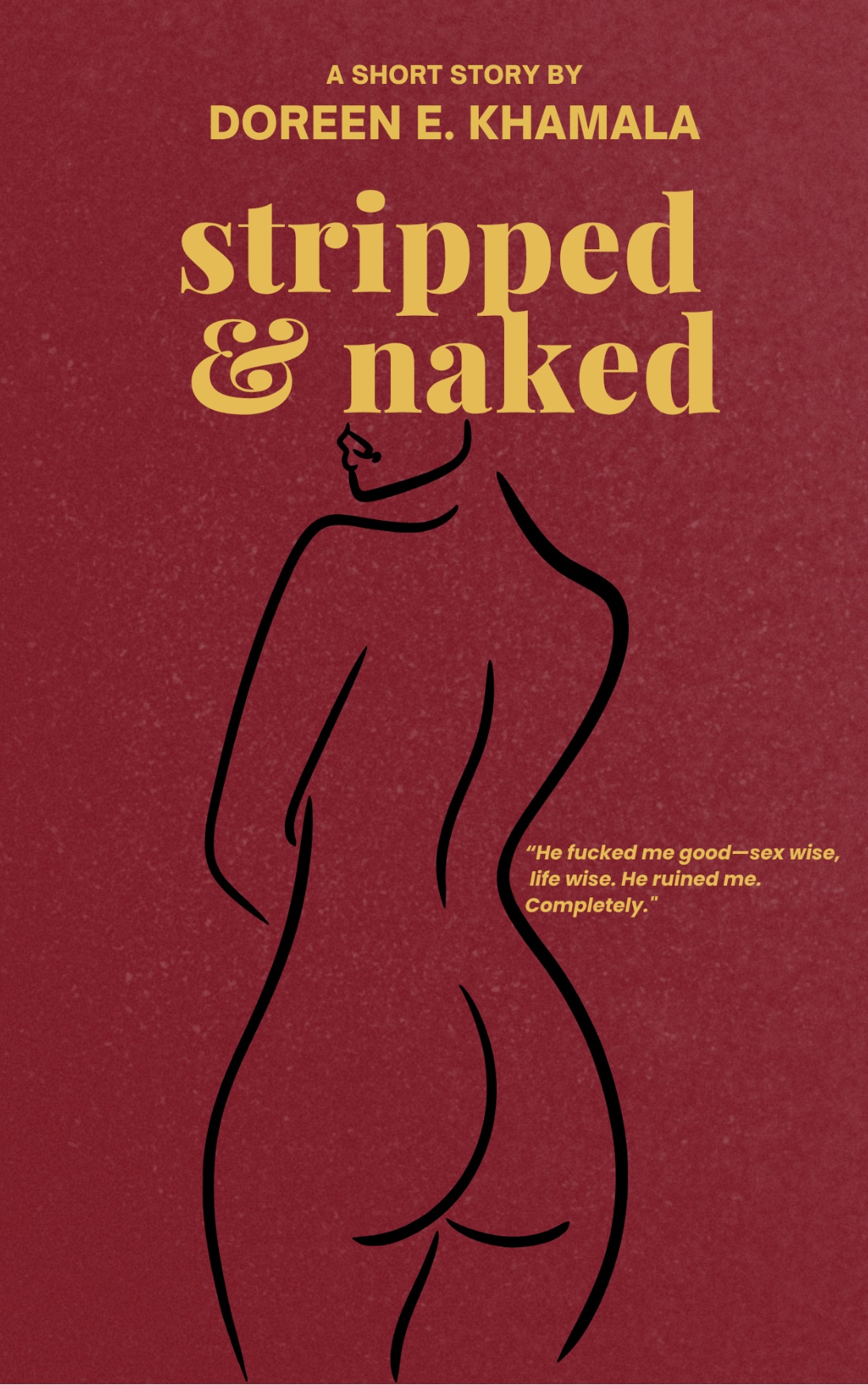
A couple of weeks back, at a radio interview, among the topics of the day that we talked about, we talked about “making it” as creative people and how creative drive motivates one to thrive. It was a great conversation, however, that conversation started with the host asking what I did, followed by me saying, “I’m a writer.” Then she asked what kind of writing I did.
And guys, I totally fucked up:
Me: Fiction!
Host: What kind of fiction? You’ve written 5 books? What are they about?
Me: LyKe, I DunNoOOooOOOO, romance stuFFFFF? I have a short story collection! 2 prose poetry and 2 novels and I’m currently werking on another novel lyKe R1ght NOWWWWWW. It’s dark romance. Like really dark.
I mean, I’m paraphrasing but I’m pretty sure that’s how I came off.
Have Some Damn Confidence
Look, if you’re trying to come off like a writer, then get your head up your ass a bit.
I don’t know why I always hold back when I tell people about my writing career. Typically, when I meet new people, I always say where I work first (because that’s how I make money) and THEN talk about “how I do some writing on the side”. This is always where people get interested and wanna know details and I ALWAYS HOLD BACK.
Anyways! The point of this story is, you spent months, maybe years, writing it. But can you talk about your book confidently in sixty seconds? This guide covers every situation where you will need to introduce your book. From a chance encounter at a networking event, a book signing, a stage to a book fair, this is what I have learned.
Part 1: Why talking about your book is hard
Writers are trained to show, not tell. We craft entire worlds from suggestion and subtext. So when someone asks “what is your book about?” and expects an answer in thirty seconds, something inside us rebels. The book is 300 pages. How do we compress it?
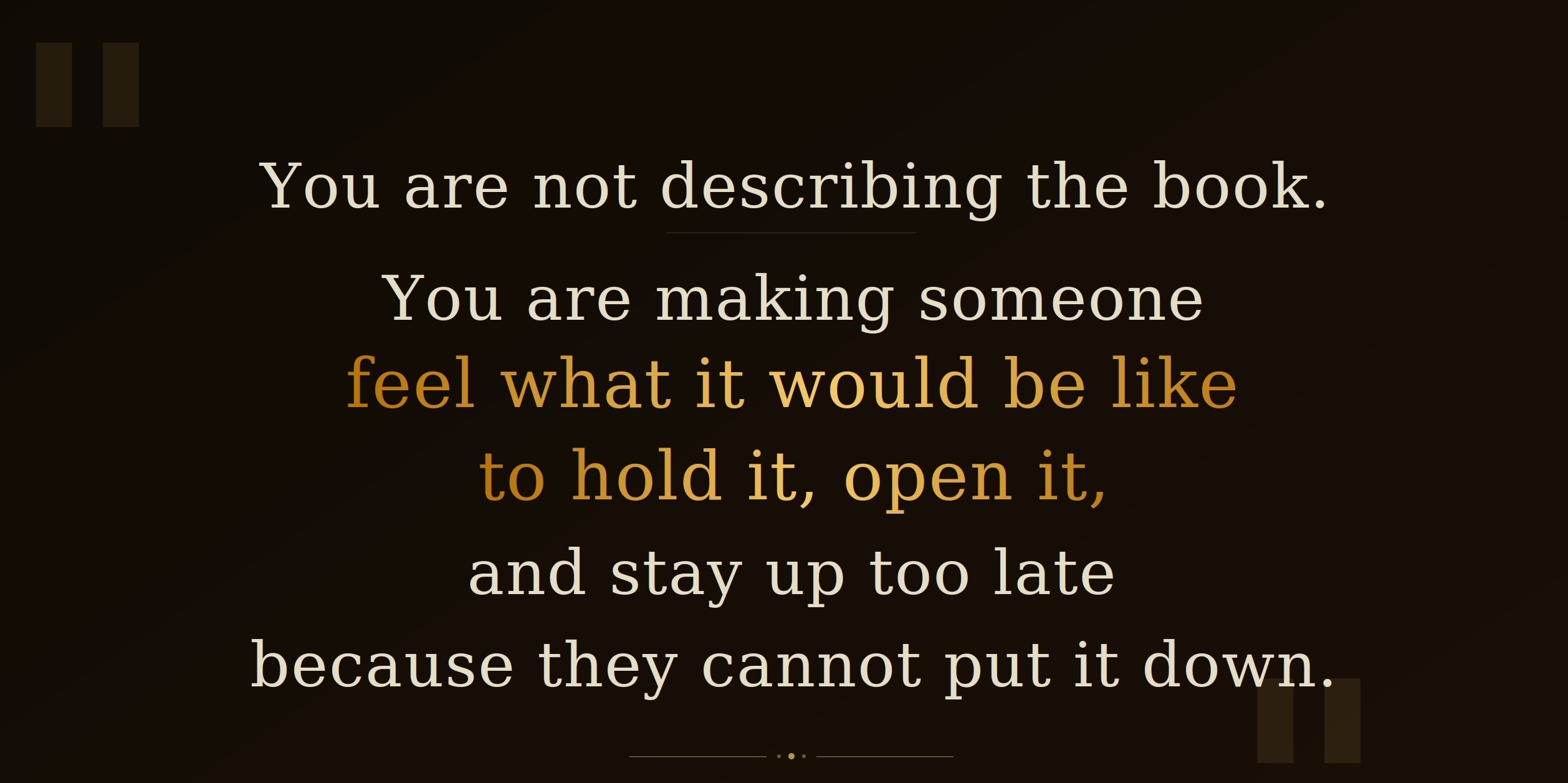
The answer is that you are not compressing the book. You are selling the experience of reading it. You are answering a different question, not “what happens?” but “why should I care?” That shift in thinking is everything.
Kenyan authors face an additional layer: we are sometimes explaining our context to audiences, local or diaspora, who may not know Kisumu, Gikomba, or the texture of a Nairobi night. Part of your pitch is also world-building in miniature. This guide will help you do both.
Part 2: The logline: your book in one sentence
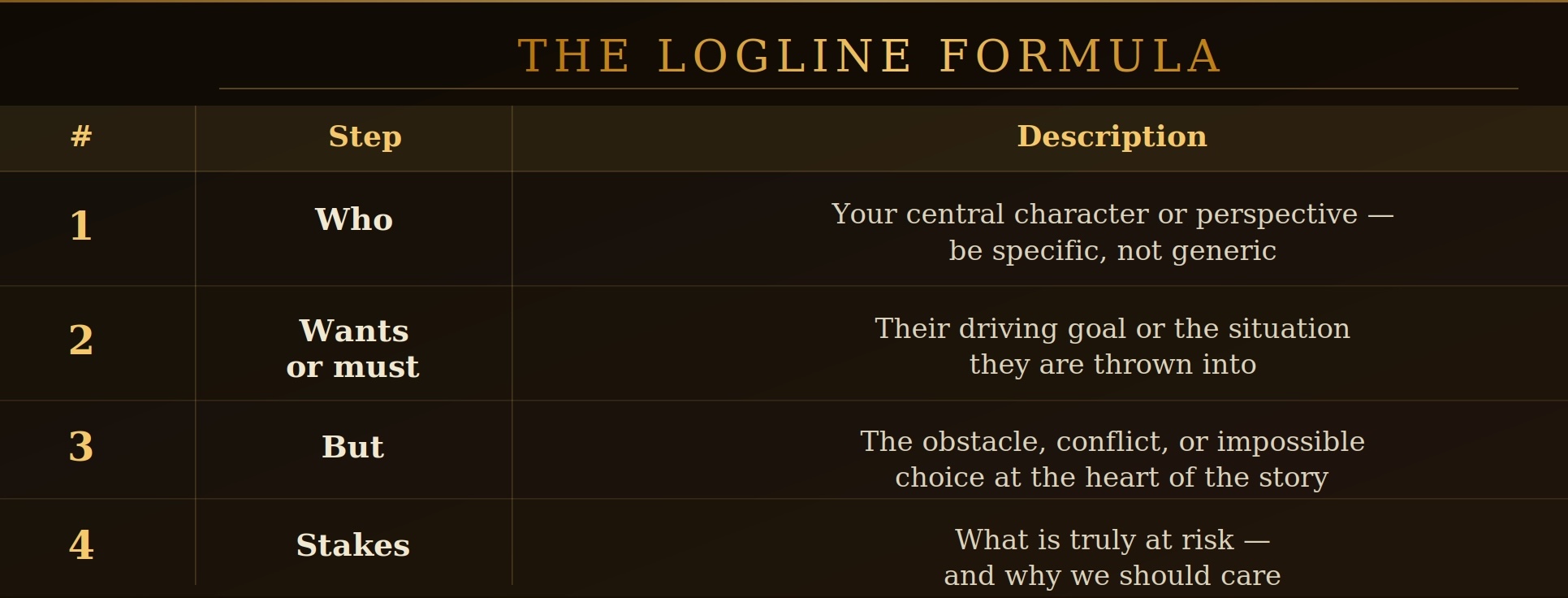
A logline is a single, well-crafted sentence that captures the soul of your book. It is the sentence you will repeat a thousand times. It lives on your social media bio, in your email signature, in the first line of every pitch. Getting it right is worth more than any other communication skill you develop as an author.
Examples Across Genres
a) Literary Fiction
EXAMPLE: A woman returns to her village in Murang’a after fifteen years in Nairobi to care for her dying mother and discovers that the life she left behind has been quietly building a story about her that she never consented to.
Notice: specific place, specific time pressure, specific emotional wound. Not a story about family and belonging.
b) Children’s book
EXAMPLE: Zawadi is ten years old and desperate to enter her school’s science competition, but when her experiment goes wrong on the morning of the fair, she has to choose between cheating to win or telling the truth and losing everything she has worked for.
Even children’s books need real stakes. ‘A girl learns about science’ is not a logline. Stakes in books are the consequences, risks, and emotional, physical, or social costs a character faces if they fail to achieve their goals
c) Non-fiction/Memoir
EXAMPLE: The story of how I built a logistics company from a single borrowed motorbike in Eldoret into a business serving 200 clients across three counties and the seven times I nearly quit along the way.
Non-fiction loglines lead with transformation and tension, not topic.
d) Poetry Collection
EXAMPLE: Forty poems that follow one Nairobi woman through grief, desire, faith, and the particular kind of loneliness that comes from being surrounded by ten million people who do not know your name.
Poetry collection can have loglines too. Frame the emotional arc, not the form.
Write ten different loglines for your book. Show them to someone who has not read it. Ask them which one makes them want to pick it up. That is your logline.
Part 3: The elevator pitch
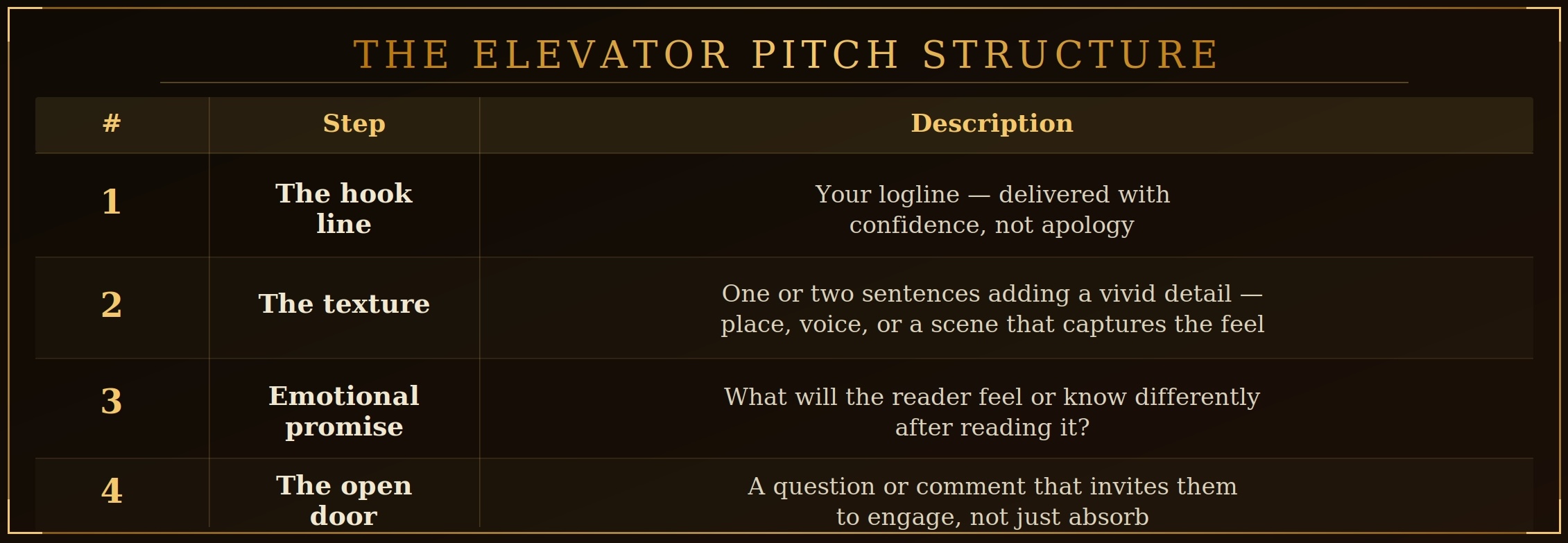
The elevator pitch is your logline expanded just enough to breathe. It is what you say when someone has one minute of genuine interest. It works at networking events, bookshop browsing moments, WhatsApp voice notes to potential readers, and the first thirty seconds of any media interview.
a) Thriller at a corporate networking event
FULL EXAMPLE: My novel follows a night-shift security guard at a Westlands tower block who witnesses something he was not supposed to see, and spends the rest of the book trying to figure out whether reporting it will get him killed or set him free.
It is set entirely across one week in Nairobi, and I wanted it to feel like the city itself is a character — the traffic, the power cuts, the way Nairobi makes you feel both completely anonymous and completely exposed.
I think anyone who has ever kept a secret they did not choose to keep will recognise something in it. Are you much of a thriller reader?
b) Literary fiction at a festival
FULL EXAMPLE: It is a novel about three sisters in Mombasa who inherit their grandmother’s house and discover, inside a wall, letters that reveal she had a life before them that she never spoke of.
The book moves between 1962 and today, and I was really interested in what it means to love someone and yet never fully know them. For me, it is also a love letter to Old Town Mombasa: the architecture, the food, the way Swahili carries history inside it.
Have you spent much time on the Coast?
c) Business/Self-help at a professional conference
FULL EXAMPLE: I wrote a book for Kenyan entrepreneurs who are building without the safety nets that most business books assume you have. No bank loan, no family wealth, no formal mentors.
It profiles twenty founders across Kenya, from a woman running a solar-powered cold storage cooperative in Kitui to a tech founder in Kisumu who has never set foot in Nairobi’s startup scene.
The central argument is that the jua kali economy has always had its own systems of capital and trust — we just have not been writing them down. What sector are you working in?
Adapt the register of your pitch to the room. At a creative writing festival, lead with theme and voice. At a business conference, lead with insight and relevance. The book does not change, the angle of entry does.
Part 4: Situation by Situation, the right pitch for every room
There is no single universal way to introduce your book. The best authors have a handful of versions: different lengths, different angles, different openings that they deploy depending on who they are talking to and why.
a) The Book Launch Introduction – 2 to 3 minutes
A book launch is the one moment where you get to say everything, briefly. The audience is already there for you. Do not waste it on plot summary. Tell them why this book exists.
EXAMPLE – Launch speech opening for a debut novel
Thank you for being here. I want to tell you something about where this book came from before I tell you what it is about.
I grew up in Mathare. And I noticed early on that the stories told about Mathare in newspapers, in textbooks, in films were almost never told by the people who lived there. They were stories told about us. Outsiders looking in, usually with either pity or fear.
The Weight of Morning is my attempt to write from the inside. It follows a single family across three days in 2019. Ordinary days that become extraordinary through the pressure of small choices. No one dies dramatically. There are no gunshots. But there is a mother trying to protect her children from a system that does not see them, and a son trying to become something his neighbourhood has been told is not for people like him.
I hope you will read it. I hope it will make you feel something true about a part of this city that most of Kenya looks away from. And I hope that after tonight, you will tell someone else to read it too.
This introduction does four things: establishes the author’s authority, names the problem the book responds to, gives the emotional core without plot-dumping, and ends with a clear ask.
b) The radio or podcast introduction
EXAMPLE: Radio interview opening (fiction)
My book is called Dust Season and it is a crime novel set during the drought years in northern Kenya, Marsabit specifically. The central character is a woman livestock officer who discovers that the emergency relief supplies meant for her community are being stolen by the very officials sent to distribute them.
And she has to decide: does she report it through channels she already knows are compromised, or does she do something that will cost her everything? It is a thriller, but it is also a book about what justice looks like when the system is the problem.
Short, crisp, leaves the interviewer wanting to ask more. Resist the urge to keep going.
Part 5: The written book description – back cover & online
The back-cover blurb is not a summary. It is a seduction. Its job is not to tell the reader everything, it is to make them unable not to open the book. Study blurbs from authors you admire.
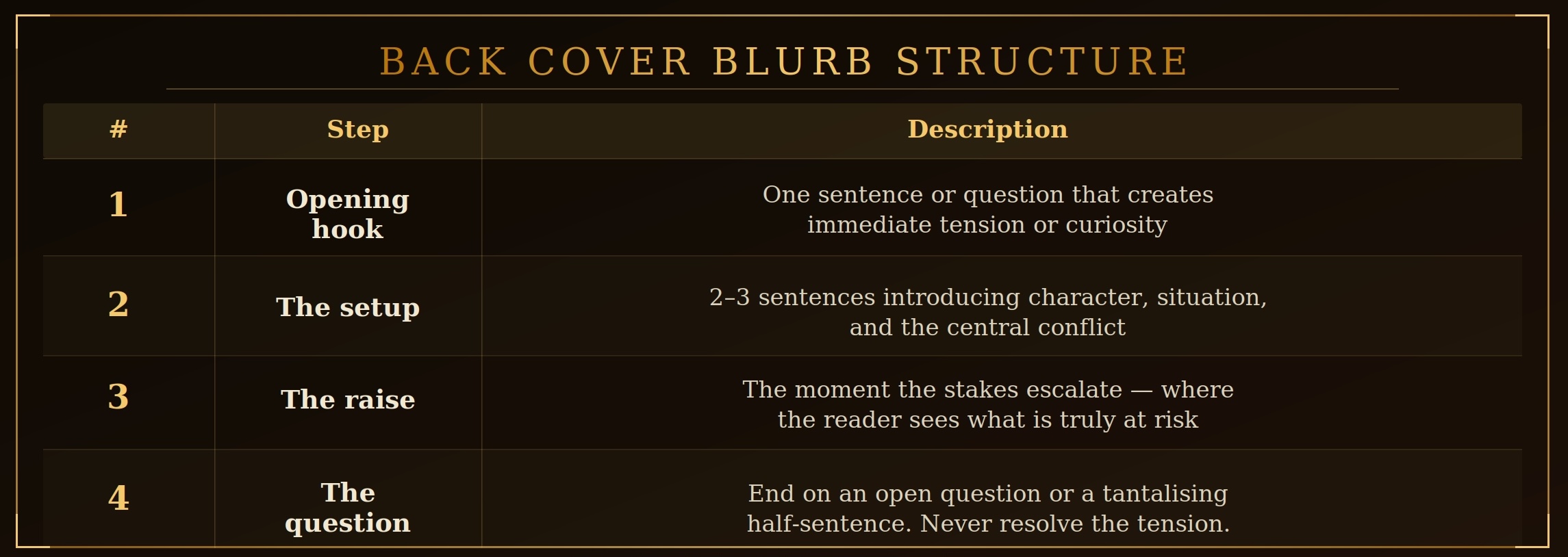
EXAMPLE of back cover blurb for a Literary Fiction:
Some silences are a kind of violence
When Zawadi returns to Mombasa after twelve years in Nairobi, she tells herself it is only to settle her mother’s estate. The house on Mvita Street. The furniture. The papers. But the papers are not what she expects, and the woman she finds inside them is not the mother she thought she knew.
Set across one sweltering week in Old Town, The Salt of Her Years is a novel about the stories families keep and the people they protect. As Zawadi uncovers the layers of her mother’s life, she must ask herself a harder question: what stories is she keeping from her own children?
Some truths wait patiently. Others have claws.
The blurb opens with a thematic statement, builds character and setting efficiently, raises the stakes, and ends on a line that makes you need to read it.
EXAMPLE of a back cover blurb for a Thriller:
Everyone in Nairobi is running from something. Detective Omondi thought he was running towards justice.
When the daughter of a Cabinet Minister goes missing two days before an election, Omondi is called back from suspension to handle a case that nobody else will touch. The investigation is simple enough until the leads start pointing not outward, but back, toward the people who have controlled Omondi’s career for fifteen years.
To solve this case, he will have to betray someone he loves. The question is who.
The Clean Hands, because in Nairobi, everyone has them. Until they do not.
EXAMPLE of back cover blurb for a Poetry Collection:
Matatu Psalm is a collection of forty-three poems written on, about, and because of Nairobi, the city that destroys you quietly and saves you loudly.
These poems move through grief and desire, through the particular loneliness of faith and the unexpected warmth of strangers on public transport. They are written in English, Kiswahili, and Sheng, because that is how Nairobi talks to itself.
For anyone who has ever loved a city that did not love them back.
Poetry blurbs often work best when they are short and emotionally direct. Describe the feeling, not the content.
Part 6: Talking about your book on social media
Social media is where most Kenyan readers will first encounter your book. It is not a place for blurbs, it is a place for conversation, glimpses, and personality. The goal is not to advertise your book but to make people feel like they know you and your work well enough to want to be part of it.
Content types that actually work
THE ‘WHY I WROTE THIS’ POST: Three years ago I was sitting in a matatu on Ngong Road and I overheard a conversation that I could not stop thinking about. A woman telling her friend she had just found out her husband had another family. Not in the dramatic way, quietly, through a school fees receipt. That conversation became the first chapter of Two Houses. It is out now. Link in bio.
THE PROCESS POST: I rewrote Chapter Seven eleven times. Eleven. It is a chapter about a five-minute phone call. But those five minutes carry the whole weight of the book. If you read The Salt of Her Years, you will know which call I mean.
THE READER RESPONSE POST: Got a message last night from a reader in Kisumu who said she had to put the book down in the middle of Chapter Four because she needed to call her mother. That is the review I will remember longest.
THE CONTEXT POST (ESPECIALLY USEFUL FOR DIASPORA OR INTERNATIONAL AUDIENCES: For anyone reading Dust Season outside Kenya: Marsabit County is in northern Kenya, near the Ethiopian border. It is one of the most beautiful and most underserved places I have ever been. This book is set there because I needed you to see it.
Do not post ‘buy my book’ more than once a week. Spend four days out of five being interesting about your writing life, your reading, your Kenya. Then one day making a clear, confident ask. That ratio is the difference between an author people follow and an author people mute.
Part 7: Handling questions about your book confidently
Once you have introduced your book, people will ask questions. Some are wonderful. Some are strange. Some are thinly veiled critiques. Here is how to handle the most common ones.
“Is it autobiographical?”
WHAT THEY REALLY MEAN: IS THIS YOUR STORY? ARE YOU THIS CHARACTER? How to answer: ‘All fiction is autobiographical and none of it is. I drew on my experience of growing up in Eastlands. The sounds, the pace, the particular quality of light in the morning. But the characters are not me. They became themselves somewhere in the writing, as they always do.’
“Why did you choose this topic?” How to answer: ‘I did not entirely choose it. I started writing about something else and found this underneath it. The story of land and inheritance in Kenya was always there, I just had to be honest about how much it had been sitting in me.’ Specificity beats generality every time.
“Who is your audience?” WHAT NOT TO SAY: ‘EVERYONE!’ — How to answer instead: ‘I wrote it first for Kenyan readers for people who will recognise the smell of the market I describe without me having to explain it. But I think anyone who has navigated a system designed to keep them out will find something in it.’
“What do you want readers to take away?” How to answer: ‘I do not want to prescribe that, I wrote the book, not the reading experience. But if I am honest, I hope it unsettles people slightly. Not in a dark way. Just enough that they look at the city, or their family, or their own assumptions a little differently on the walk home.’
Do not dismiss critical questions, but you are also not obligated to defend your book. ‘That is a fair reading. I see it differently, but I appreciate you engaging with it’ is a complete answer.
Part 8: The most common mistakes, and how to fix them
Most errors in book introductions come from the same place: uncertainty about whether you deserve to be talking about your work at all. You do. Here is the clearest guide to what helps and what hurts.
✅ DO THIS:
- Say the title clearly and repeat it once
- Commit to one angle per audience
- Speak about your book as if it already belongs in the world
- Say, “I wrote this because….” at some point
- Know your logline so well you could say it half asleep
- End with an open question or invitation
- Let silence do work after a key line
❌ STOP DOING THIS
- Apologising for your book before anyone has read it
- Saying “it is kind of hard to explain”
- Giving a plot summary instead of an emotional promise
- Qualifying with “I hope” and “I tried to”
- Comparing yourself unfavourably to other authors
- Talking about the writing process when asked what is it about
- Filing the silence after your pitch with more words.
The moment you stop apologising for your book and start inviting people into it, everything changes in the room and in you.
Your book deserves a champion. That champion is you. Not because no one else will do it, but because no one else can do it the way you can. You know why it exists. You know what it cost to write. You know the reader you were thinking of when you wrote the last page. That knowledge is your pitch. Trust it.
6 Comments
This is very Informative, the details are on point.
Thank you for reading. I am so glad it resonates with you.
This is really good.
You are great at this Doreen Khamala Books
Thank you so much and thank you for reading.
This is the most important thing I’ve read this morning. Thank you.
Thank you, I’m honored it connected with you. That’s exactly why I write.. 🥂